
0
Better Quantum Computers with Koheras Fiber Lasers | Koheras 광섬유 레이저로 구현하는 차세대 양자컴퓨터
Better Quantum Computers with Koheras Fiber Lasers
Explore how Koheras fiber lasers provide the precision and stability needed for advanced quantum computing applications. Get high qubit quality with Koheras industry-ready fiber laser systems – designed for ultra-cold atom-based quantum computers.
Quantum computers are one of the most groundbreaking technologies of our time. Lasers play a crucial role in quantum computing by cooling and trapping atoms to create stable qubits. Narrow linewidth and high power stability are essential for precise control, while fiber delivery ensures consistent beam quality. Koheras lasers offer the required wavelength coverage, scalability, and reliability for advanced quantum applications.
Using Lasers for Quantum Computing
Cold-atom systems are among the leading candidates for quantum computers. Lasers can cool atoms down and trap them in place using advanced techniques like Doppler cooling and dipole trapping. These cold atoms can then be manipulated, entangled, and read with more advanced lasers and imaging techniques, creating high-quality qubits in quantum computers.
Quantum computers can perform operations far beyond what classical computers can handle. They will become crucial for applications like drug discovery, financial optimization, supply chain management, and solving fundamental scientific problems.
Key Considerations When Choosing a Laser
When picking a laser for atom trapping, cooling, and manipulation, there are several things to consider:
- Narrow linewidth & power stability
- Wavelength coverage
- Fiber delivery
- Scalability & industrial reliability
Why Narrow Linewidth and Power Stability Matter
When choosing lasers for trapping, cooling, and manipulating atoms, two key factors stand out: narrow linewidth and power stability.
Linewidth refers to the width of the laser’s frequency spectrum. Phase noise in the system causes the linewidth to expand. The linewidth has a significant impact on how well cooling and manipulation techniques work. In Doppler cooling, for instance, the linewidth must be much smaller than the atom’s natural linewidth. If the laser’s linewidth is too broad, it limits the cooling efficiency and the precision of experiments.
Power stability refers to a laser’s ability to maintain consistent power over time without fluctuations. Power stability is essential for maintaining consistent cooling rates and ensuring reproducible experiments. Intensity fluctuations, or relative intensity noise (RIN), can add unwanted heat to the system and limit cooling effectiveness.
NKT Photonics fiber lasers are engineered to meet these demanding requirements. They are thermally and mechanically isolated to minimize power fluctuations. With linewidths in the 1-100 Hz range, these lasers are among the narrowest available.
Wavelength Coverage for Versatile Quantum Computing
Quantum computing requires lasers that can cover a wide range of wavelengths, from the ultraviolet (UV) to the infrared (IR). Different atomic species have specific transitions in these regions. To explore their potential, access to these wavelengths is required.
Koheras fiber lasers offer broad wavelength coverage, covering important UV, visible, and IR wavelengths, including those necessary for ion and neutral atom-based quantum computers. This flexibility allows researchers to explore a wide range of atoms and develop more robust quantum systems.
Fiber Delivery for Reliable Light Transmission
When it comes to quantum computing, especially when scaling systems, reliable light delivery is essential. Fiber-coupled lasers reduce power losses and maintain high beam quality over long distances.
NKT Photonics fiber lasers are inherently single-mode, stable, and mode-hop-free, which is key for high-precision quantum applications. Combined with photonic crystal fiber technology, these lasers deliver high-power, narrow-linewidth light without compromising beam stability.
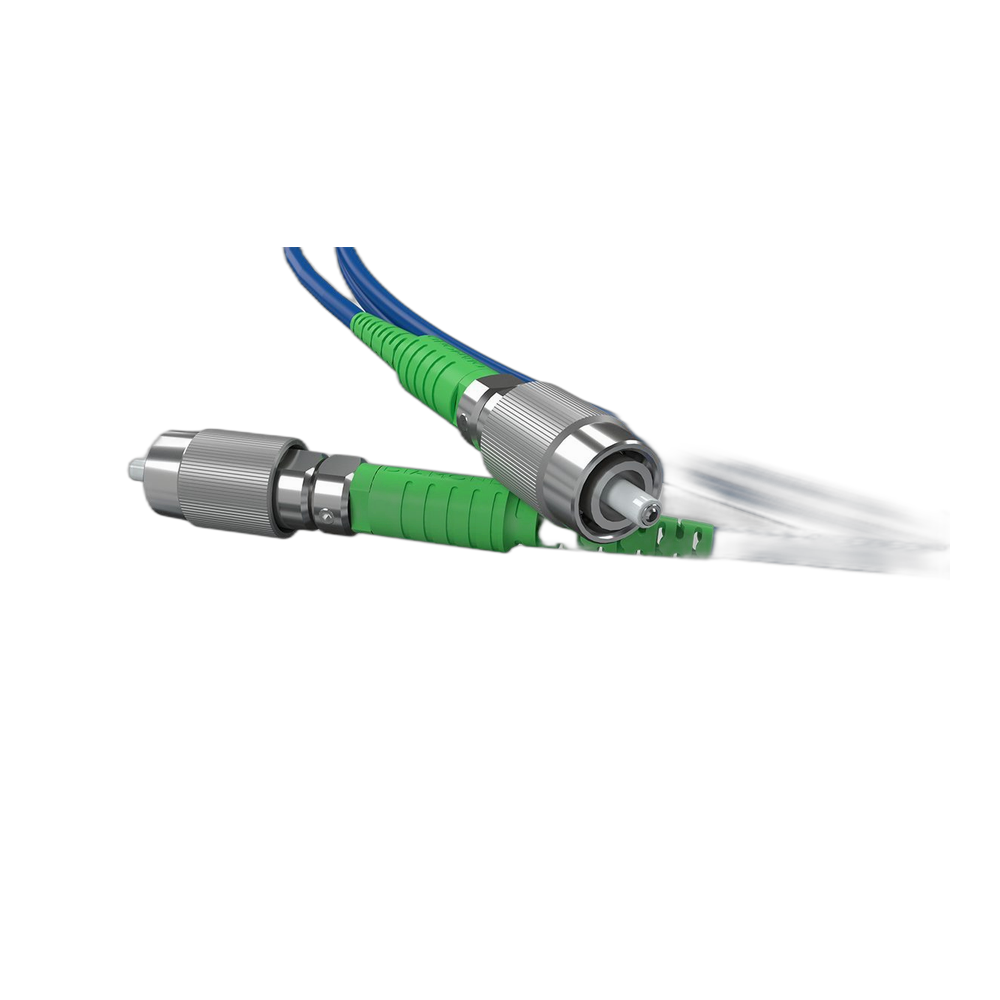
Whether rack-mounting the laser system or using it in a tabletop setup, the aeroGUIDE POWER fiber delivery system offers the flexibility needed for seamless light delivery. It is designed to transport light at all power levels with unmatched beam stability, ensuring precise and consistent light delivery for quantum experiments.
Scalability & Industrial Reliability
With over 20 years of experience and more than 20,000 single-frequency fiber lasers deployed globally, NKT Photonics systems are designed for scalability and reliability. These lasers are engineered to meet the toughest industrial demands, offering an exceptional mean time between failures of over 30 years, making them ideal for long-term, high-volume applications in quantum research.
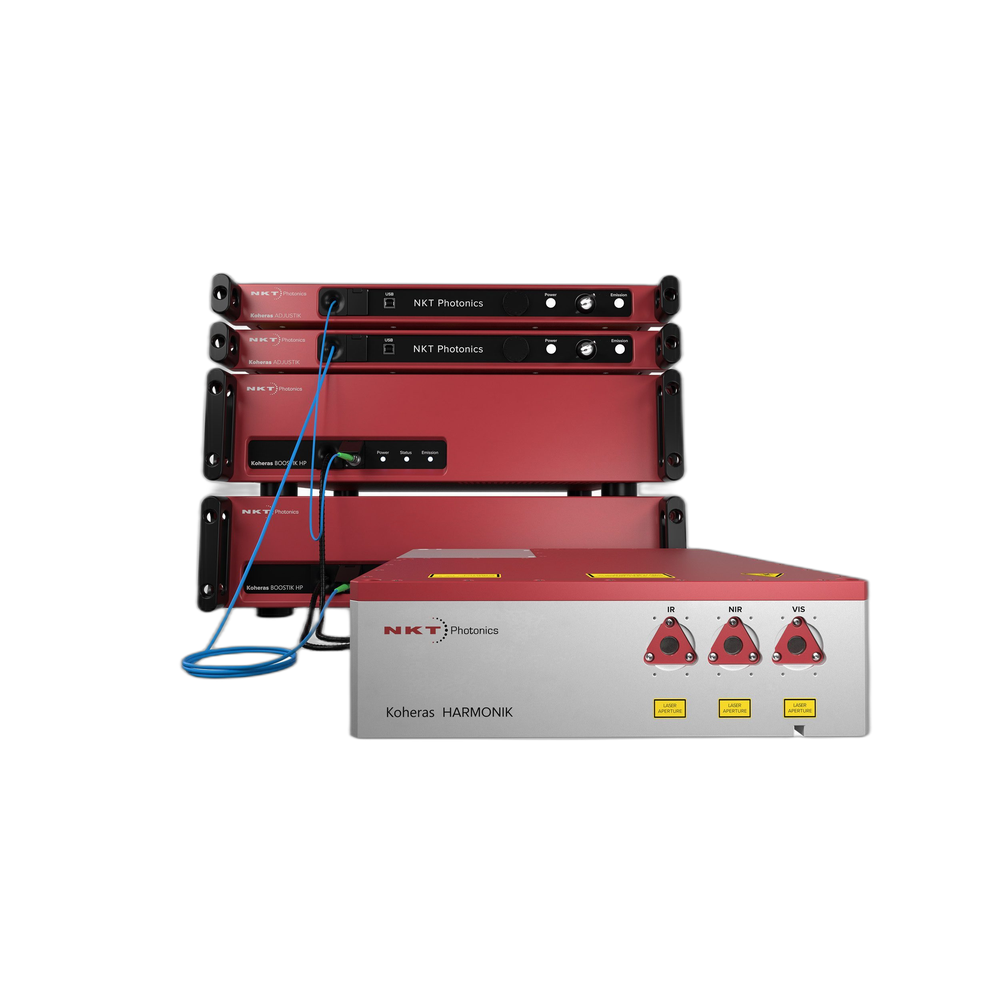
The Koheras HARMONIK is designed specifically for trapping and cooling atoms in quantum applications. The HARMONIK offers everything needed for demanding quantum experiments – from cooling atoms to manipulating qubits, all with unbeatable reliability.
How Do You Make Cold Atoms?
When cooling and trapping atoms with lasers, it is important to understand that – at the atomic scale – temperature makes atoms wiggle around. Reducing their movement is equivalent to reducing their temperature. Atoms can be cooled by carefully matching the atom with a laser that can emit light with the properties needed to cool that specific atom.
To cool an atom, it must absorb energy only when it randomly moves toward the laser. After a short while, the atom begins to reemit the absorbed light in random directions. On average, this makes the atom slow down in the direction of the laser because it loses net kinetic energy in that direction.
Adding a beam in all three dimensions forces the atom to slow down in all directions. This technique allows atoms to be cooled to well below 1 K, depending on the type of atom.
The goal is to make the atom absorb light only when moving in a specific direction. Atoms can only absorb light if the light is oscillating at one of the discrete frequencies allowed by the atom. For rubidium, one of these frequencies corresponds to light with a wavelength of 780 nm. If the wavelength is longer, the rubidium atom will not absorb it.
In a laser Doppler cooling system, the wavelength of the laser must be slightly longer than required for absorption. When the atom moves toward the laser, the Doppler effect causes the atom to experience the laser as emitting light at a shorter wavelength. The atom will absorb a photon. When moving away from the laser source, the atom experiences the wavelength as longer and nothing happens.
A magneto-optical trap (MOT) can be used to shoot light at the atom from both directions and in all three dimensions. This cools rubidium atoms down to a few µK, making them ready to be put to work. In some systems, the atoms are transferred to other laser cooling systems to lower the temperature further before they are used.
NKT Photonics Quantum Engagements
NKT Photonics is part of the European Quantum Flagship, the European Quantum Industry Consortium (QuIC), the Quantum Economic Development Consortium (QED-C), and the Danish Quantum Community.
Related Products
Koheras 광섬유 레이저로 구현하는 차세대 양자컴퓨터
Koheras 광섬유 레이저가 첨단 양자컴퓨팅 응용에 필수적인 정밀도와 안정성을 어떻게 제공하는지 살펴봅니다. 극저온 원자 기반 양자컴퓨터를 위해 설계된 Koheras 산업용 광섬유 레이저 시스템으로 고품질 큐비트를 구현할 수 있습니다.
양자컴퓨터는 현시대 가장 혁신적인 기술 중 하나입니다. 레이저는 원자를 냉각하고 포획하여 안정적인 큐비트를 만드는 데 핵심적인 역할을 합니다. 정밀한 제어를 위해서는 좁은 선폭(narrow linewidth)과 높은 출력 안정도가 필수적이며, 광섬유 전송(fiber delivery)은 일관된 빔 품질을 보장합니다. Koheras 레이저는 첨단 양자 응용에 필요한 파장 범위, 확장성, 신뢰성을 모두 제공합니다.
양자컴퓨팅을 위한 레이저 활용
냉각 원자(cold-atom) 시스템은 양자컴퓨터의 유력한 후보 중 하나입니다. 레이저는 도플러 냉각(Doppler cooling)과 쌍극자 포획(dipole trapping)과 같은 고급 기법을 사용하여 원자를 냉각하고 특정 위치에 포획할 수 있습니다. 이렇게 냉각된 원자는 더욱 정밀한 레이저와 이미징 기술로 조작·얽힘·측정되어 양자컴퓨터 내 고품질 큐비트로 활용됩니다.
양자컴퓨터는 기존 컴퓨터로는 처리할 수 없는 연산을 수행할 수 있습니다. 신약 개발, 금융 최적화, 공급망 관리, 기초 과학 문제 해결 등의 응용 분야에서 핵심 기술로 자리잡을 것입니다.
레이저 선택 시 주요 고려사항
원자 포획, 냉각, 조작을 위한 레이저를 선택할 때 고려해야 할 주요 항목은 다음과 같습니다:
- 좁은 선폭(narrow linewidth) 및 출력 안정도
- 파장 범위
- 광섬유 전송
- 확장성 및 산업용 신뢰성
좁은 선폭과 출력 안정도가 중요한 이유
원자 포획·냉각·조작용 레이저를 선택할 때 가장 중요한 두 가지 요소는 좁은 선폭과 출력 안정도입니다.
선폭(Linewidth)은 레이저 주파수 스펙트럼의 폭을 의미합니다. 시스템 내 위상 잡음(phase noise)이 선폭을 넓게 만듭니다. 선폭은 냉각 및 조작 기법의 성능에 큰 영향을 미칩니다. 예를 들어 도플러 냉각에서는 레이저 선폭이 원자의 자연 선폭보다 훨씬 좁아야 합니다. 레이저 선폭이 너무 넓으면 냉각 효율과 실험 정밀도가 제한됩니다.
출력 안정도(Power stability)는 시간에 따른 출력 변동 없이 일정한 출력을 유지하는 능력을 의미합니다. 출력 안정도는 일관된 냉각률을 유지하고 실험 재현성을 확보하는 데 필수적입니다. 강도 변동, 즉 상대 강도 잡음(RIN, Relative Intensity Noise)은 시스템에 원치 않는 열을 추가하여 냉각 효과를 저하시킬 수 있습니다.
NKT Photonics 광섬유 레이저는 이러한 까다로운 요구사항을 충족하도록 설계되었습니다. 열적·기계적으로 차폐되어 출력 변동을 최소화하며, 1~100 Hz 수준의 선폭으로 업계 최고 수준의 좁은 선폭을 제공합니다.
다양한 양자컴퓨팅 응용을 위한 파장 범위
양자컴퓨팅에는 자외선(UV)부터 적외선(IR)까지 넓은 파장 범위를 제공할 수 있는 레이저가 필요합니다. 원자 종류마다 해당 파장 영역에 고유한 전이가 존재하므로, 이러한 파장에 접근할 수 있어야 다양한 가능성을 탐색할 수 있습니다.
Koheras 광섬유 레이저는 이온 및 중성 원자 기반 양자컴퓨터에 필요한 UV·가시광·IR 파장을 포함한 광범위한 파장 범위를 제공합니다. 이러한 유연성을 통해 다양한 원자 종을 탐색하고 더 견고한 양자 시스템을 개발할 수 있습니다.
신뢰성 있는 광 전송을 위한 광섬유 전송
양자컴퓨팅, 특히 시스템 확장 시 신뢰성 있는 광 전송은 필수적입니다. 광섬유 결합 레이저는 출력 손실을 줄이고 장거리에서도 높은 빔 품질을 유지합니다.
NKT Photonics 광섬유 레이저는 본질적으로 단일 모드(single-mode), 안정적, 모드 홉(mode-hop) 없는 동작을 제공하여 고정밀 양자 응용에 적합합니다. 광결정 광섬유(photonic crystal fiber) 기술과 결합하여, 빔 안정성을 저해하지 않고 고출력의 좁은 선폭 광을 전송합니다.
랙 마운트 형태나 테이블탑 셋업 모두에서, aeroGUIDE POWER 광섬유 전송 시스템은 매끄러운 광 전송에 필요한 유연성을 제공합니다. 모든 출력 수준에서 비교 불가능한 빔 안정성으로 광을 전송하도록 설계되어, 양자 실험에 정밀하고 일관된 광 전송을 보장합니다.
확장성 및 산업용 신뢰성
20년 이상의 경력과 전 세계에 20,000대 이상 설치된 단일주파수 광섬유 레이저 실적을 바탕으로, NKT Photonics 시스템은 확장성과 신뢰성을 갖추도록 설계되었습니다. 가장 까다로운 산업용 요구를 충족하도록 엔지니어링된 이 레이저는 평균 고장 간격(MTBF) 30년 이상의 뛰어난 성능을 제공하여, 장기간·대량 양자 연구 응용에 이상적입니다.
Koheras HARMONIK은 양자 응용에서 원자 포획 및 냉각을 위해 특별히 설계되었습니다. HARMONIK은 원자 냉각부터 큐비트 조작까지, 까다로운 양자 실험에 필요한 모든 것을 비교 불가능한 신뢰성으로 제공합니다.
냉각 원자는 어떻게 만드는가?
레이저로 원자를 냉각·포획하려면 원자 수준에서 온도가 원자의 진동(wiggle)을 의미한다는 것을 이해해야 합니다. 원자의 움직임을 줄이는 것이 곧 온도를 낮추는 것과 같습니다. 특정 원자를 냉각하기 위해서는 그 원자에 맞는 특성의 빛을 방출하는 레이저를 정밀하게 매칭해야 합니다.
원자를 냉각하려면 원자가 무작위로 레이저 쪽으로 움직일 때만 에너지를 흡수하도록 해야 합니다. 잠시 후 원자는 흡수한 빛을 무작위 방향으로 재방출하기 시작합니다. 평균적으로, 이 과정에서 원자는 레이저 방향의 운동에너지를 잃기 때문에 그 방향으로 감속됩니다.
3차원 모든 방향에 빔을 추가하면, 원자는 모든 방향에서 감속됩니다. 이 기법으로 원자를 1 K 훨씬 아래까지 냉각할 수 있으며, 정확한 온도는 원자 종류에 따라 달라집니다.
핵심은 원자가 특정 방향으로 움직일 때만 빛을 흡수하도록 하는 것입니다. 원자는 자신에게 허용된 이산 주파수(discrete frequency)의 빛만 흡수할 수 있습니다. 루비듐(rubidium)의 경우, 이 주파수 중 하나가 780 nm 파장의 빛에 해당합니다. 파장이 더 길면 루비듐 원자는 이를 흡수하지 않습니다.
레이저 도플러 냉각 시스템에서는 레이저의 파장이 흡수에 필요한 파장보다 약간 더 길어야 합니다. 원자가 레이저 쪽으로 움직이면 도플러 효과로 인해 원자는 레이저가 더 짧은 파장의 빛을 방출하는 것처럼 인식하고 광자(photon)를 흡수합니다. 레이저 광원에서 멀어질 때는 파장이 더 길어진 것으로 인식되어 아무 일도 일어나지 않습니다.
자기광학 트랩(MOT, Magneto-Optical Trap)을 사용하면 양방향 및 3차원 모든 방향에서 원자에 빛을 쏘아 보낼 수 있습니다. 이를 통해 루비듐 원자를 수 µK까지 냉각할 수 있으며, 이후 실제 연구에 활용됩니다. 일부 시스템에서는 원자를 추가 레이저 냉각 시스템으로 전송하여 사용 전 온도를 더 낮춥니다.
NKT Photonics의 양자 관련 활동
NKT Photonics는 유럽 양자 플래그십(European Quantum Flagship), 유럽 양자산업 컨소시엄(QuIC, European Quantum Industry Consortium), 양자경제개발 컨소시엄(QED-C, Quantum Economic Development Consortium), 그리고 덴마크 양자 커뮤니티(Danish Quantum Community)의 회원사입니다.
관련 제품
Source / 원문 출처
Source: This article is based on the original content published by NKT Photonics.
Original URL: https://www.nktphotonics.com/applications/quantum-nano-technology/quantum-computing/
Publisher: NKT Photonics A/S (https://www.nktphotonics.com)
Translation: Translated and republished by Cali Instruments for Korean readers. All rights to the original content belong to NKT Photonics A/S.
출처: 본 게시글은 NKT Photonics에서 발행한 원문을 기반으로 작성되었습니다.
원문 링크: https://www.nktphotonics.com/applications/quantum-nano-technology/quantum-computing/
발행처: NKT Photonics A/S (https://www.nktphotonics.com)
번역: 한국 독자를 위해 칼리인스트루먼트(Cali Instruments)에서 번역 및 재게시했습니다. 원문에 대한 모든 권리는 NKT Photonics A/S에 있습니다.