0
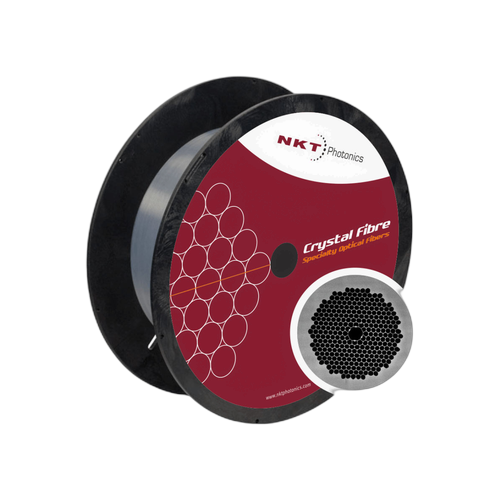
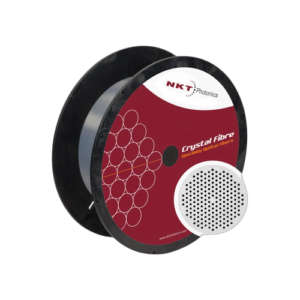
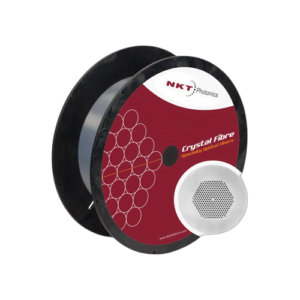
NKT Photonics 중공코어 광자결정 파이버 Hollow-Core Photonic Crystal Fiber
Air-core PBG fiber; 50× lower nonlinearity, ultra-low bend loss, ideal for ultrashort pulse delivery and high-power transmission.
공기코어 PBG 파이버; 비선형성 50배 감소, 극저 굽힘 손실, 초단 펄스 전달 및 고출력 전송 최적.
Description
NKT Photonics’ hollow-core photonic crystal fibers (HC-PCF) guide light through an air-filled core using the photonic bandgap (PBG) effect, making them fundamentally different from conventional solid-core fibers. Because light propagates primarily in air, these fibers offer drastically reduced nonlinear effects (>50× vs. silica), reduced sensitivity to temperature transients (~6.5×), Faraday effect (>10×), and near-zero dispersion in the guiding band. They are also virtually insensitive to bending, even at very small radii.
NKT Photonics 중공코어 광자결정 파이버는 광자 밴드갭(PBG) 효과를 이용해 공기가 채워진 코어로 빛을 안내합니다. 빛이 주로 공기 중에서 전파되므로 비선형 효과가 획기적으로 감소(실리카 대비 50배 이상)하며, 온도 과도 특성, 패러데이 효과에 대한 민감도가 낮고 굽힘 반경에도 강합니다.
Key Features
- Light guidance in air via photonic bandgap effect
- >50× reduction in Kerr nonlinearity vs. silica fiber
- Ultra-low bend sensitivity — guides even at very small bending radii
- Dramatically reduced temperature transient sensitivity (~6.5×)
- Reduced Faraday effect (>10×)
- Anomalous dispersion values in the thousands of ps/nm/km range
- 광자 밴드갭 효과를 통한 공기 내 광안내
- 실리카 파이버 대비 커 비선형성 50배 이상 감소
- 극저 굽힘 민감성 — 매우 작은 굽힘 반경에서도 안내
- 온도 과도 민감성 획기적 감소 (~6.5배)
- 패러데이 효과 감소 (10배 이상)
- 수천 ps/nm/km 수준의 이상 분산 특성
Applications
- Ultrashort pulse delivery without dispersion or nonlinear distortion
- High-power laser delivery without fiber damage risk
- Gas sensing and gas-filled fiber devices
- Quantum and atomic physics experiments
- Low-latency optical data transmission
- 분산·비선형 왜곡 없는 초단 펄스 전달
- 파이버 손상 위험 없는 고출력 레이저 전달
- 기체 감지 및 기체 충전 파이버 소자
- 양자 및 원자 물리 실험
- 저지연 광데이터 전송
Specifications
| Parameter | Specification |
|---|---|
| Guidance mechanism | Photonic bandgap (air-core) |
| Guiding wavelength range | Limited band (~200 nm BW @ 1550 nm) |
| Nonlinearity reduction | >50× vs. silica (Kerr effect) |
| Bend sensitivity | Almost insensitive (even at very small radii) |
| Temperature sensitivity reduction | ~6.5× vs. conventional fiber |
| Faraday effect reduction | >10× vs. conventional fiber |
| Dispersion | Anomalous, thousands of ps/nm/km possible |
| Available wavelengths | ~800 nm, ~1060 nm, ~1550 nm bands |
📎 원본 제품 페이지: https://www.nktphotonics.com/products/type/hollow-core-photonic-crystal-fibers/