0
Park Systems Accurion RSE 참조 분광 타원편광분석기 Referenced Spectroscopic Ellipsometer
High-speed referenced spectroscopic ellipsometer — 200 spectra/sec, 100×100 mm mapping in 12 min, 0.1 nm–10 µm thickness range for quality control.
고속 참조 분광 타원편광분석기, 초당 200 스펙트럼, 100×100mm 매핑 12분, 0.1nm~10µm 두께 범위.
Description
The Referenced Spectroscopic Ellipsometer (RSE) is an ellipsometer-based reflectometer, designed for high-speed thickness mapping in quality control. It allows to accurately measure thicknesses ranging from 0.1 nm to 10 µm. With 200 complete spectra recorded per second, a 100 mm × 100 mm area can be investigated in only 12 minutes while acquiring 67,000 spectra.
The RSE combines the high sensitivity of an ellipsometer with the measurement speed of a reflectometer, and even exceeds it. In comparison to a laser ellipsometer, it includes the spectroscopic information between 450 and 900 nm. Essentially, referenced methods are more sensitive than absolute methods — the RSE method is superior to conventional ellipsometry when very thin layers are in focus.
참조 분광 타원편광분석기(RSE)는 품질 관리의 고속 두께 매핑을 위해 설계된 타원편광분석기 기반 반사계입니다. 0.1 nm ~ 10 µm 범위의 두께를 정확히 측정할 수 있으며, 초당 200개의 전체 스펙트럼을 기록하여 100 mm × 100 mm 영역을 12분 만에 67,000개의 스펙트럼을 수집하며 조사할 수 있습니다.
RSE는 타원편광분석기의 높은 감도와 반사계의 측정 속도를 결합하여 이를 뛰어넘습니다. 레이저 타원편광분석기와 비교하여 450~900 nm 사이의 분광 정보를 포함합니다. 기본적으로 참조 방식은 절대 방식보다 더 민감하여, 매우 얇은 층이 초점일 때 RSE 방식이 기존 타원편광분석법보다 우수합니다.

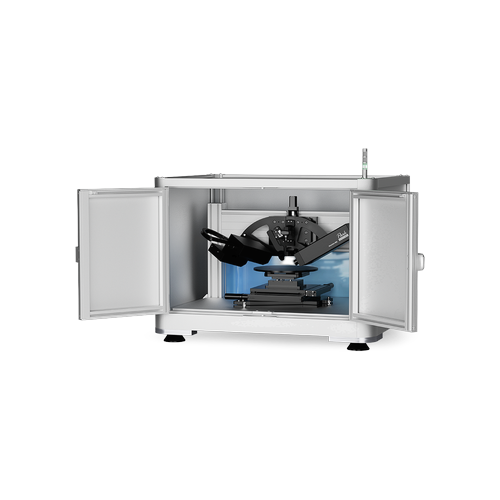
Accurion RSE — in-house ellipsometric reference system for high-speed film thickness mapping
Accurion RSE — 고속 박막 두께 매핑을 위한 참조 타원편광분석 시스템
Key Features
- “Single-shot” referenced spectroscopic ellipsometric measurements — No optical components need to be moved or modulated during measurement; full high-resolution spectrum obtained in a single shot.
- Data rate of 200 spectra per second — 100 mm × 100 mm area investigated in 12 minutes with 67,000 spectra acquired.
- Live data processing — Look-up table (LUT) fitting enables real-time film thickness evaluation at full data rate.
- Micro spot measurement — Spot size: 25 × 40 µm at AOI = 60°, enabling localized measurements on small features.
- Wide film thickness range — Accurately measures from <1 nm to 10 µm.
- Spectral range 450–900 nm — Spectroscopic information across visible range, essential when multiple layer parameters vary simultaneously.
- “단일 샷” 참조 분광 타원편광 측정 — 측정 중 광학 부품 이동 또는 변조 불필요. 단일 샷에서 전체 고해상도 스펙트럼 획득.
- 초당 200 스펙트럼 데이터 속도 — 100 mm × 100 mm 영역을 12분에 67,000개 스펙트럼 수집하며 조사.
- 실시간 데이터 처리 — 룩업 테이블(LUT) 피팅으로 전체 데이터 속도에서 박막 두께를 실시간으로 평가.
- 마이크로 스팟 측정 — 스팟 크기: AOI = 60°에서 25 × 40 µm, 소형 피처에 대한 국소 측정 가능.
- 넓은 박막 두께 범위 — <1 nm ~ 10 µm를 정확히 측정.
- 450~900 nm 분광 범위 — 가시광선 영역 전반의 분광 정보. 여러 층 파라미터가 동시에 변할 때 필수적.
Applications
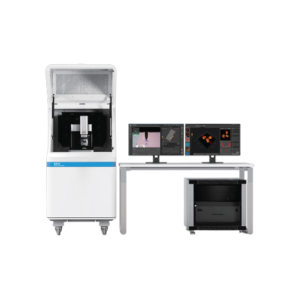
 Wafer Inspection 웨이퍼 검사 |
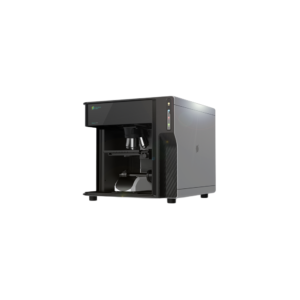
 Detection of Contaminants 오염물 검출 |
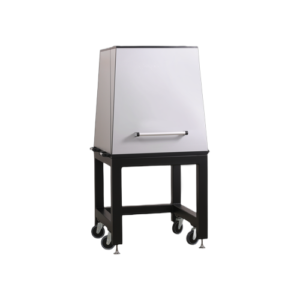
 Thickness of Ultrathin Films 초박막 두께 측정 |
 Thickness of Interlayer 층간 두께 측정 |
- Semiconductor wafer inspection — layer thickness uniformity in quality control
- Detection of surface contaminants and particles
- Ultrathin film characterization (<1 nm) — native oxides, SAMs, monolayers
- Interlayer thickness measurement in multilayer stacks
- Optical density and refractive index determination (450–900 nm)
- 반도체 웨이퍼 검사 — 품질 관리의 층 두께 균일성
- 표면 오염물 및 입자 검출
- 초박막 특성 분석 (<1 nm) — 자연 산화막, SAM, 단층막
- 다층 스택에서 층간 두께 측정
- 광학 밀도 및 굴절률 결정 (450~900 nm)
Specifications
Accurion RSE의 주요 사양입니다. 자세한 사양은 견적 요청 시 안내드립니다.
| Parameter | Specification |
|---|---|
| Measurement Speed | |
| Data rate | 200 complete spectra per second |
| Mapping — 100 mm × 100 mm | 12 minutes (67,000 spectra) |
| Measurement mode | “Single-shot” (no moving/modulating optical components) |
| Measurement Range | |
| Film thickness range | <1 nm – 10 µm |
| Spectral range | 450 – 900 nm |
| Spot size | 25 × 40 µm (at AOI = 60°) |
| Data Processing | |
| Fitting method | Look-up table (LUT) — real-time live fitting |
| Output parameters | Complex refractive index, film thickness |
| Stage | |
| XY stage | Synchronized motorized XY stage |
| Method | |
| Ellipsometry type | Referenced Spectroscopic Ellipsometry (RSE) |
| Advantage vs. conventional | Higher sensitivity for very thin layers; higher speed than reflectometry |
📎 원본 제품 페이지: https://www.parksystems.com/en/products/ellipsometers/referenced-spectroscopic-ellipsometry-