0
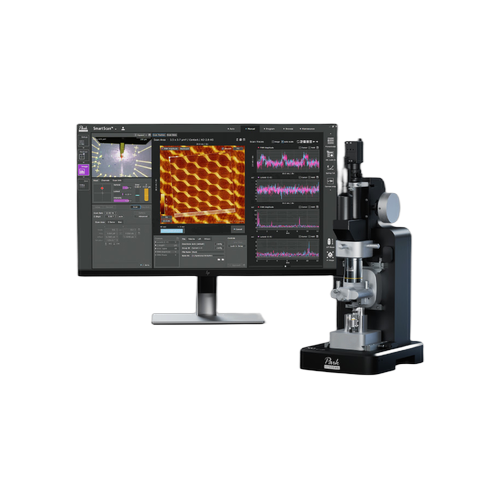
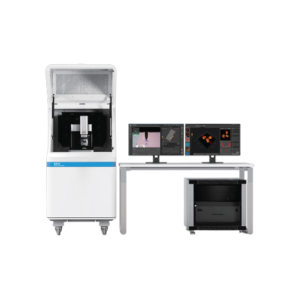
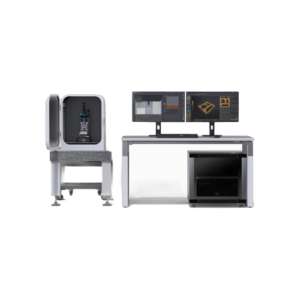
Park Systems NX1 원자현미경 Atomic Force Microscope
The highest-resolution AFM for atomic-scale imaging in ambient conditions, with optional qPlus sensor and Kovar core body for thermal stability.
대기 환경 원자 분해능 AFM, qPlus 센서 옵션 및 Kovar 본체로 열안정성 확보.
Description
Park NX1 is a compact AFM designed for high-resolution imaging with stable operation. The system combines a mechanically rigid structure with a thermally stable body to support atomic-scale imaging in ambient conditions while maintaining the ease of use typical of Park Systems instruments. A minimal mechanical loop between the probe and the sample improves mechanical stability. The AFM core body is made of Kovar to reduce thermal drift.
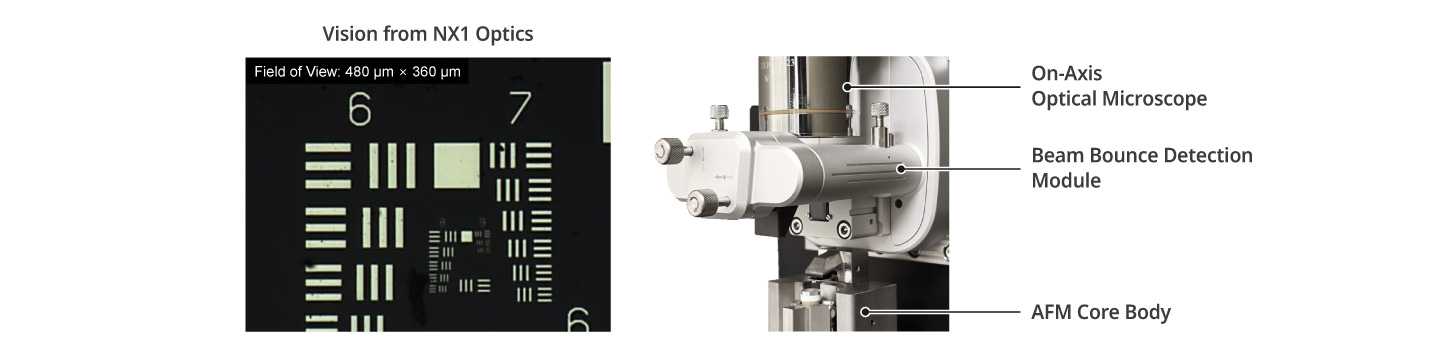
The system includes a XYZ tube scanner for imaging and a tungsten carbide stick–slip stage with kinematic contacts for Z approach. The sample can be positioned using stick–slip XY motion. An on-axis optical microscope allows observation of both the probe and the sample during operation. The system supports standard AFM probes as well as optional qPlus (quartz tuning fork) sensors.
Developed in collaboration with Prof. Franz J. Giessibl of the University of Regensburg — one of the world’s foremost authorities on atomic-resolution AFM — the NX1 brings imaging performance previously confined to ultra-high vacuum environments into the reach of research labs worldwide.
Park NX1은 안정적인 작동과 고해상도 이미징을 위해 설계된 컴팩트 AFM입니다. 기계적으로 견고한 구조와 열적으로 안정한 본체를 결합하여 대기 환경에서 원자 스케일 이미징을 지원하며, Park Systems 제품 특유의 사용 편의성을 유지합니다. 프로브와 시료 사이의 기계적 루프를 최소화하여 기계적 안정성을 향상시켰으며, AFM 코어 본체는 열 드리프트를 줄이기 위해 Kovar 합금으로 제작되었습니다.
이미징을 위한 XYZ 튜브 스캐너와 Z 접근을 위한 운동학적 접점을 갖춘 텅스텐 카바이드 stick–slip 스테이지를 포함합니다. 시료는 stick–slip XY 운동으로 위치 조정이 가능합니다. 동축 광학 현미경으로 작동 중 프로브와 시료를 모두 관찰할 수 있습니다. 표준 AFM 프로브뿐만 아니라 옵션 qPlus(쿼츠 튜닝 포크) 센서도 지원합니다.
원자 분해능 AFM 분야의 세계적 권위자인 Regensburg 대학교 Franz J. Giessibl 교수와의 협력으로 개발된 NX1은 그동안 초고진공 환경에서만 가능했던 이미징 성능을 전 세계 연구실에서 사용할 수 있도록 합니다.
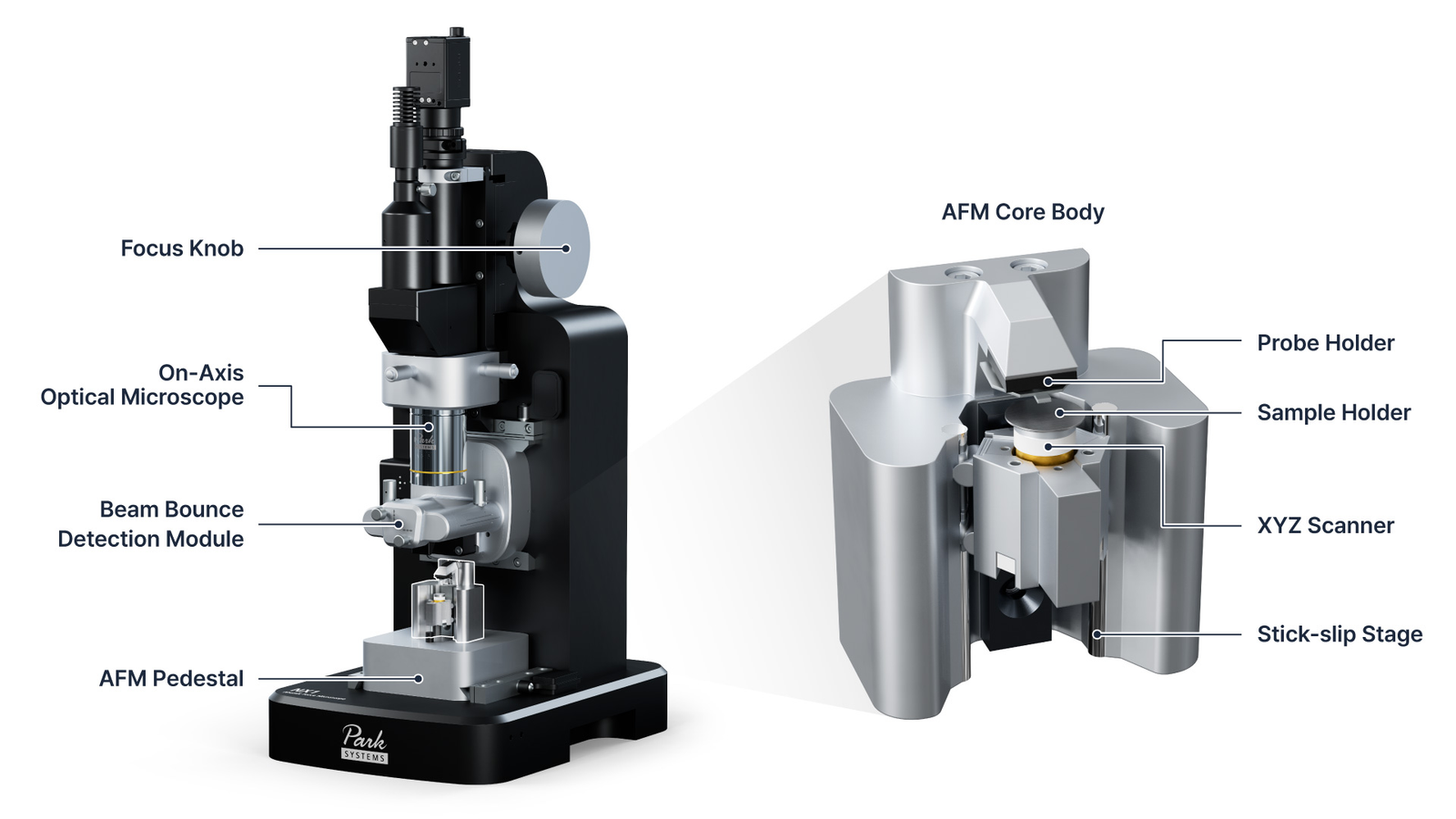
NX1 hardware schematic with labeled key components
NX1 하드웨어 구성 다이어그램 (주요 부품 표시)
Key Features
- Optimized AFM Architecture — Compact, mechanically rigid architecture minimizes the probe-to-sample mechanical loop, enabling low noise and high stability. Precision XYZ tube scanner combined with tungsten carbide stick–slip stage and kinematic contacts enables stable positioning, while low thermal expansion materials reduce drift for consistent atomic-resolution imaging.
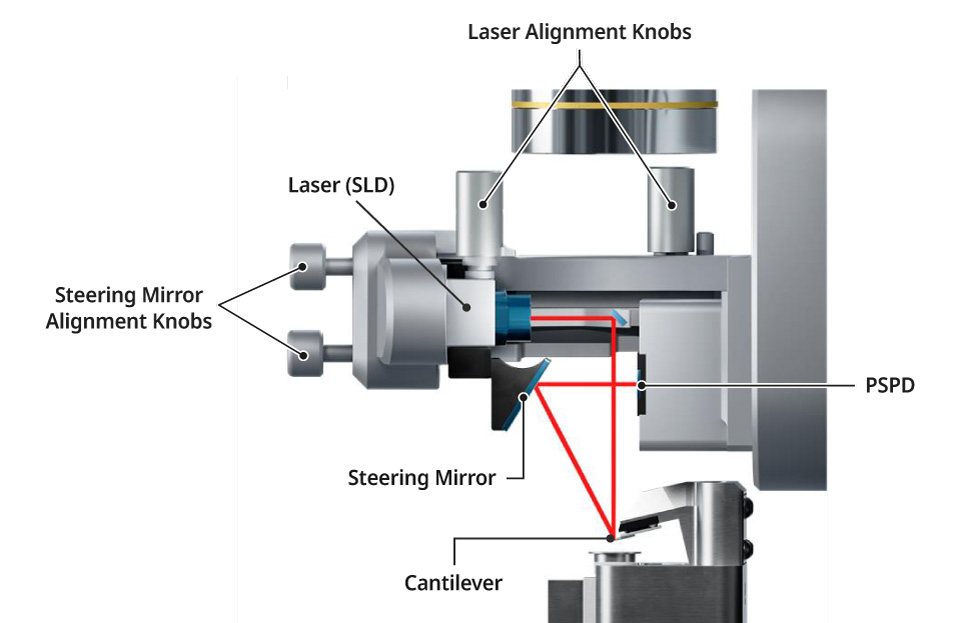
- Intuitive Laser Beam Alignment — Beam-bounce detection system with a separated detection module preserves measurement stability. The intuitive alignment design simplifies setup and enables fast laser positioning on the cantilever, supporting stable signal detection.
- Low Noise Performance — Noise floor about an order of magnitude lower than typical AFM systems, enabled by the optimized architecture. This low noise level provides a stable measurement environment, supporting consistent signal detection and atomic-resolution imaging.
- On-Axis Optical Microscope — High-resolution on-axis optical microscope provides a direct view of both the probe and sample, enabling accurate tip positioning and efficient sample navigation. Integrated illumination provides clear visibility across sample types.
- qPlus® Sensor Option — Optional qPlus sensor based on a quartz tuning fork enables advanced atomic-scale measurements. Its high stiffness enables stable operation at picometer-scale amplitudes, minimizing jump-to-contact.
- Kovar Core Body — Low thermal expansion Kovar alloy core body reduces thermal drift for stable, repeatable atomic-resolution imaging in ambient laboratory conditions.
- 최적화된 AFM 구조 — 컴팩트하고 기계적으로 견고한 구조가 프로브-시료 기계 루프를 최소화하여 저잡음 및 고안정성을 구현합니다. 정밀 XYZ 튜브 스캐너와 텅스텐 카바이드 stick–slip 스테이지, 운동학적 접점이 결합되어 안정적인 위치 조정을 지원하며, 저열팽창 재료로 드리프트를 줄여 일관된 원자 분해능 이미징을 가능하게 합니다.
- 직관적인 레이저 빔 정렬 — 분리된 검출 모듈을 갖춘 beam-bounce 검출 시스템이 측정 안정성을 유지합니다. 직관적인 정렬 설계로 셋업이 간소화되며, 캔틸레버에 빠른 레이저 포지셔닝이 가능하여 안정적인 신호 검출을 지원합니다.
- 저잡음 성능 — 최적화된 구조 덕분에 일반 AFM 시스템보다 약 한 자릿수 낮은 잡음 플로어를 달성했습니다. 이 저잡음 수준은 안정적인 측정 환경을 제공하여 일관된 신호 검출과 원자 분해능 이미징을 지원합니다.
- 동축 광학 현미경 — 고해상도 동축 광학 현미경이 프로브와 시료를 동시에 직접 관찰할 수 있게 하여 정확한 팁 포지셔닝과 효율적인 시료 탐색이 가능합니다. 통합 조명으로 다양한 시료에 대해 선명한 가시성을 제공합니다.
- qPlus® 센서 옵션 — 쿼츠 튜닝 포크 기반 옵션 qPlus 센서로 고급 원자 스케일 측정이 가능합니다. 높은 강성으로 피코미터 스케일 진폭에서 안정적으로 작동하며 jump-to-contact를 최소화합니다.
- Kovar 코어 본체 — 저열팽창 Kovar 합금 코어 본체가 열 드리프트를 줄여 대기 실험실 환경에서 안정적이고 반복 가능한 원자 분해능 이미징을 제공합니다.
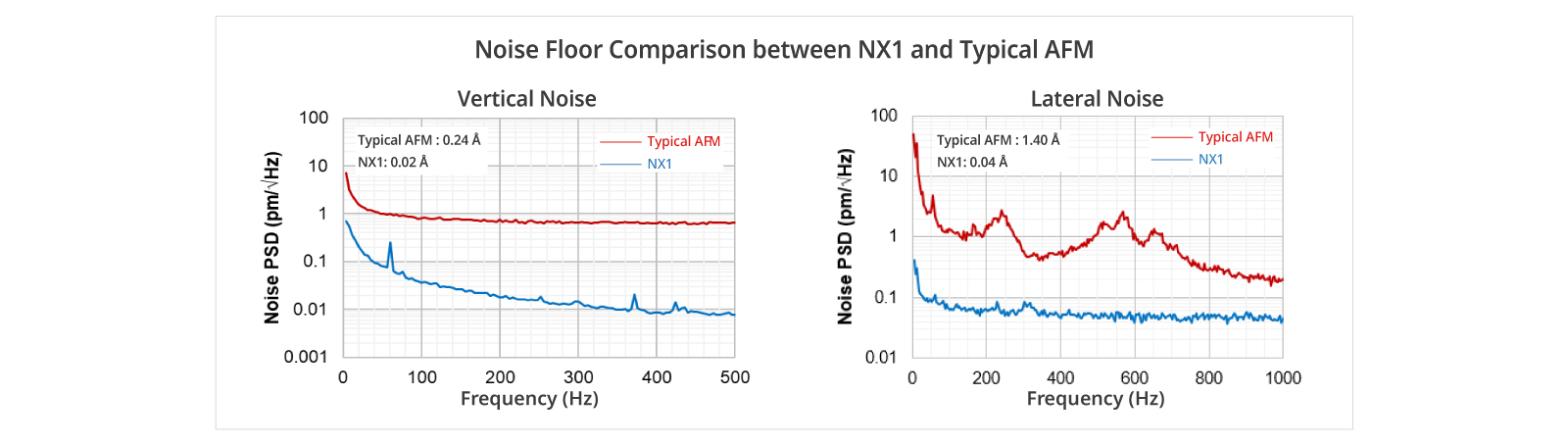
Noise floor comparison between NX1 and typical AFM systems
NX1과 일반 AFM 시스템의 노이즈 플로어 비교
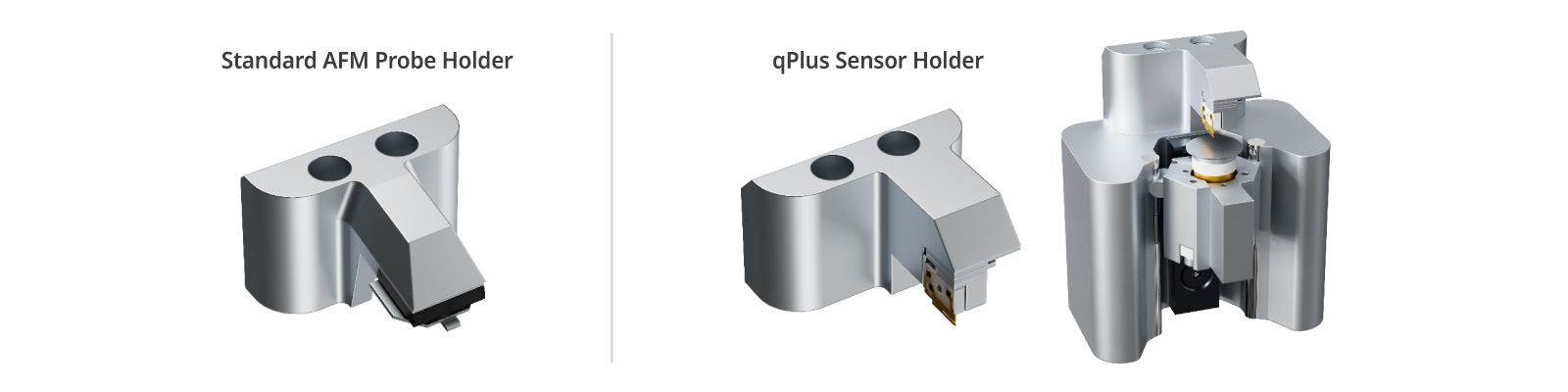
Standard AFM probe holder (left) and qPlus sensor holder (right)
표준 AFM 프로브 홀더(좌)와 qPlus 센서 홀더(우)
Applications
- 2D materials — MoS₂ single crystal, twisted bilayer graphene, HOPG, WSe₂ on graphene
- Atomic-scale surface science in ambient conditions
- Picometer-scale amplitude operation (with qPlus sensor)
- Single-atom-resolved imaging without ultra-high vacuum
- Short-range force detection with high sensitivity (qPlus option)
- 2D 소재 — MoS₂ 단결정, 트위스티드 이중층 그래핀, HOPG, 그래핀 위 WSe₂
- 대기 환경에서의 원자 스케일 표면 과학
- 피코미터 스케일 진폭 작동 (qPlus 센서 사용 시)
- 초고진공 없이 단원자 분해능 이미징
- 고감도 단거리력 검출 (qPlus 옵션)
Specifications
Park NX1의 주요 사양입니다. 자세한 사양은 견적 요청 시 안내드립니다.
| Parameter | Specification |
|---|---|
| Core Architecture | |
| Core body material | Kovar (low thermal expansion alloy) |
| Mechanical loop | Minimized probe-to-sample loop for low noise and high stability |
| Scanner | |
| Scanner type | XYZ tube scanner |
| Z approach | Tungsten carbide stick–slip stage with kinematic contacts |
| XY positioning | Stick–slip XY motion |
| Probe / Sensor | |
| Standard probe | Silicon cantilevers (standard AFM probes) |
| Optional sensor | qPlus® (quartz tuning fork) sensor |
| Oscillation amplitude (qPlus) | Picometer-scale (high stiffness, minimal jump-to-contact) |
| Detection | |
| Detection method | Beam-bounce (optical lever) with separated detection module |
| Noise floor | ~1 order of magnitude lower than typical AFM systems |
| Optics | |
| Optical microscope | High-resolution on-axis optical microscope |
| Illumination | Integrated illumination |
| Operation Environment | |
| Operating conditions | Ambient (atomic resolution achievable without UHV) |
| Software | |
| Operating software | Park SmartScan™ |
| Analysis software | Park SmartAnalysis™ |
| Development | |
| Origin | Based on Orpheus II (Prof. Franz J. Giessibl, University of Regensburg) |
📎 원본 제품 페이지: https://www.parksystems.com/en/products/research-afm/small-sample-afm/nx1